Need Help Now? Call (912) 297-1532
24 Hour Emergency Towing Service | Roadside Assistance
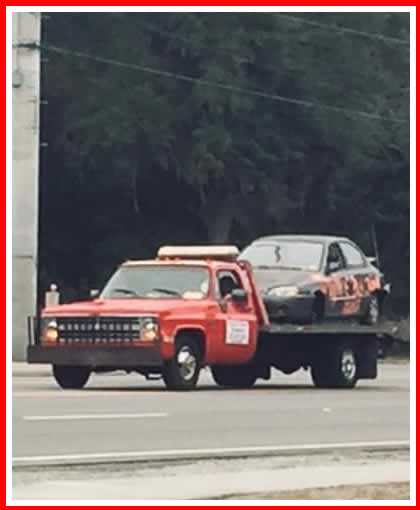
Accidents rarely look the same twice. Some of the most common recovery scenes we handle include:
Accident recovery is more than just hooking up a tow line. Damaged vehicles often won’t roll, won’t steer, or aren’t safe to move without special handling first.
Disabled Vehicle Removal
Vehicles that can’t move under their own power are loaded and removed from the scene.
Off-Road & Ditch Recoveries
Crashes often send vehicles into ditches, medians, yards, and soft ground. These situations use Winching & Off-Road Recovery before towing.
Traffic Lane Clearing
Vehicles blocking lanes are removed so traffic can flow again and secondary crashes can be avoided.
Vehicle Transport After a Wreck
Once recovered, vehicles are transported to repair shops, homes, storage yards, or other approved locations.
Recovery needs vary based on vehicle size and damage.
Smaller vehicles may only need Light Duty Towing. Work trucks often require Medium Duty Towing. Large rigs fall under Heavy Duty Towing.
Once law enforcement secures the scene, recovery begins. The damaged vehicle is assessed for stability. If the wheels won’t roll freely, winching, lifting, or controlled upright methods are used. If cargo is involved and needs to be transferred first, Load Swapping may be part of the process. After that, the vehicle is towed to the location allowed by the driver or directed by authorities.
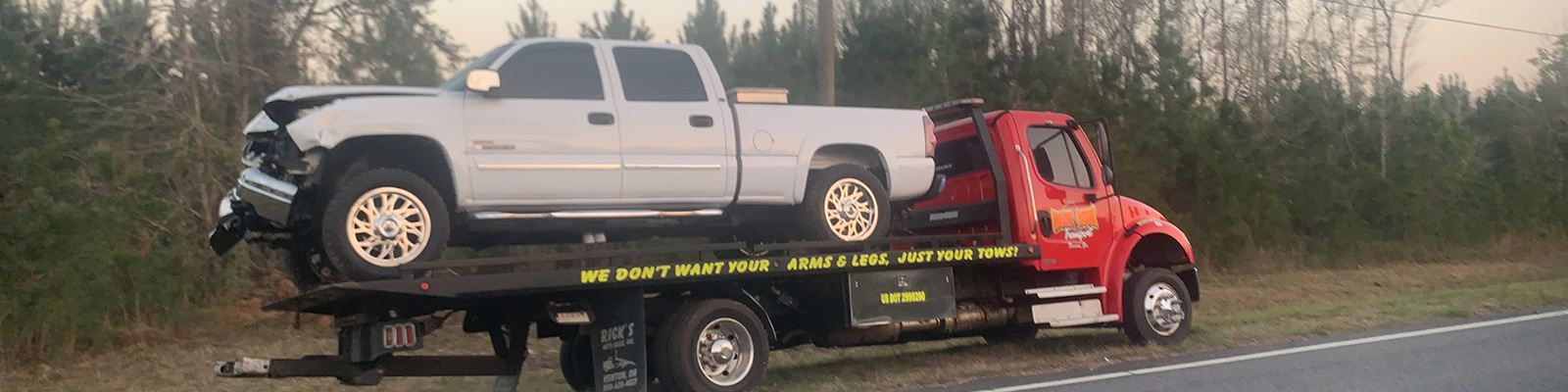
Some crashes turn into large recovery operations. Jackknifed trailers, rolled vehicles, and deep off-road slide-offs may require multiple steps to complete safely. These scenes often combine Winching & Off-Road Recovery, load transfer, and heavy towing before the road can reopen fully.
One rainy evening, a driver lost control on a curve in Sea Island and slid into a shallow ditch. The vehicle was upright but stuck deep in wet soil. A careful winch pull brought it back to pavement before towing it to a nearby repair shop.
Another call involved a work truck struck at a stoplight. The rear axle was damaged and the truck blocked two lanes of traffic. Traffic was rerouted while the truck was lifted, secured, and towed out safely. Once the truck moved, the entire area relaxed again. Those moments stay with everyone involved.
Each season brings its own recovery challenges.
Summer Travel
Heavy traffic increases crash activity, especially on unfamiliar coastal routes.
Storm Season
Rain lowers traction and visibility, leading to slide-offs and roadway accidents.
Winter Cold Snaps
Cold mornings create slick spots on bridges and shaded road areas.
In most cases, yes. Vehicles can usually be towed to a repair shop, home, or storage yard unless law enforcement directs otherwise.
Controlled upright recovery methods are used before towing.
Yes. We recover both personal and commercial vehicles after crashes.
The vehicle is secured and removed in a way that reduces additional hazards.
Yes. Vehicles in ditches, yards, woods, or fields can be recovered safely.
We tow throughout McIntosh County and Glynn County and can move vehicles to nearby cities, homes, shops, and yards as needed.
After a crash, the basic goal is simple—clear the road and move what can’t move on its own. Hook & Book Transport provides accident recovery in Sea Island across McIntosh and Glynn County for cars, trucks, and commercial vehicles of all sizes.
Call (912) 297-1532 to reach Hook & Book Transport for accident recovery in Sea Island.
Service Area Map
© Hook & Book Transport. All Rights Reserved. Web Design